BFSG Enforcement: Status in Germany
As of August 2026, no published German court decision on the BFSG is known. The market surveillance authority has been running active checks since 29 January 2026, no individual fine has been documented publicly, and the letter you are most likely to receive comes from a competitor’s law firm rather than from an authority. Whether such warning letters are legally sound has not been decided by any court.
Between what the law threatens and what actually happens there is a gap, and very few English-language sources describe it. This page collects what is documented, path by path.
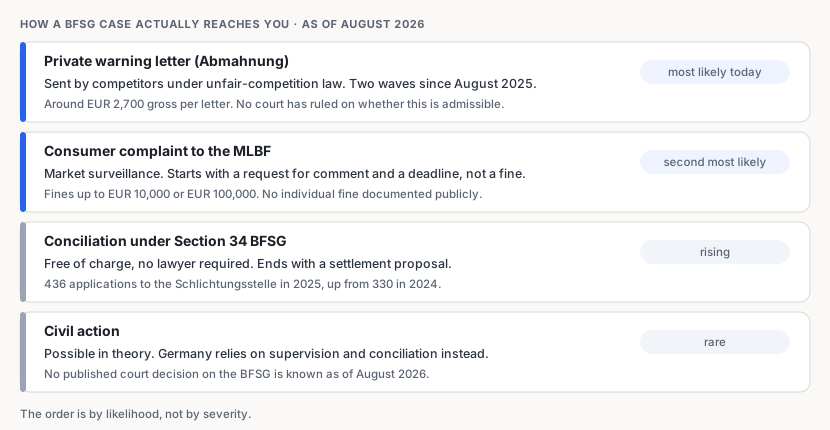 Enlarge: Ordered by likelihood, not by severity. The path with the highest legal…
This is not legal advice. This page collects the publicly documented position and does not replace legal review of an individual case. Anyone who has received a warning letter should take advice before signing anything.
Key points
- No published court decision on the BFSG is known as of August 2026. First judgments are expected in the second half of 2026. Until then any statement about how the law will be read is a forecast.
- Four enforcement paths exist, and they differ sharply in frequency: market surveillance, conciliation, private warning letters, civil action.
- The MLBF in Magdeburg has been checking on its own initiative since 29 January 2026. A case starts with a request for comment, not with a fine.
- No individual fine under Section 37 BFSG has been documented publicly. The range is up to EUR 10,000 for breaches of information duties and up to EUR 100,000 for non-accessible services.
- The most active path is the private warning letter, and legally it is the least certain. Whether BFSG provisions are market conduct rules under Section 3a UWG has not been decided.
- Conciliation applications are rising: 436 in 2025 against 330 in 2024, across all case types. Section 34 BFSG opens this route against companies.
- Three things in a warning letter are separate matters: the cease-and-desist undertaking, the costs claim, and the technical defects.
Status as of August 2026
The Marktüberwachungsstelle der Länder für die Barrierefreiheit von Produkten und Dienstleistungen (MLBF) is a joint institution of the German federal states, based in Magdeburg. It began operating at the end of September 2025 and adopted its market surveillance strategies for products and services on 29 January 2026, which ended the preparatory phase.
In March 2026 the European Commission sent Germany a reasoned opinion, the second stage of an infringement procedure, over what it considers incomplete transposition of Directive (EU) 2019/882. The deadline to respond ran to mid-May 2026. For individual companies this changes nothing directly, since the procedure is directed at the member state. It does make any softening of the requirements unlikely.
A second wave of private warning letters has been running since February 2026. It differs from the first: the letters now rest on formal test reports from external providers rather than on general assertions. Claims of around EUR 2,700 gross per letter are documented.
Path 1: private warning letters
Since August 2025 there have been waves of warning letters over missing accessibility, with a second wave from February 2026.
The decisive legal question is open. A warning letter under Section 3a of the German Unfair Competition Act requires the breached provision to be a market conduct rule, meaning it also governs the interests of market participants rather than only creating a public-law duty. Whether BFSG provisions have that quality has not been decided by any court as of August 2026. There are arguments both ways, and many specialist lawyers consider the letters sent so far vulnerable for other reasons: insufficiently specified breaches, questionable competitor status, indications of abuse.
If you receive one
Three things belong apart. They have different consequences and different deadlines.
The cease-and-desist undertaking. It binds permanently and carries a contractual penalty. Signing it commits you whether or not the warning was justified. Signing without review is the most expensive mistake in this sequence.
The costs claim. It stands or falls with the validity of the warning. This is exactly where the open legal question sits, and where legal review pays off most.
The alleged defects. They may well be real, even if the letter is unenforceable. The pragmatic route is to check and fix the findings independently of the letter. What an independent assessment involves is on BITV-Test: Accessibility Audits in Germany.
One thing I would not do is install an accessibility overlay in a panic. It does not change the reported defects and it is not evidence of anything.
Path 2: market surveillance by the MLBF
The MLBF checks in two ways. Reactively, on complaints, which the authority describes as taking priority. And actively, through its own, often automated sampling, focused on offerings with high reach, high relevance for independent living, and providers with a history of defects.
The third criterion is the one most often overlooked. Once you have come to attention, you stay in view: a resolved complaint stays on file rather than closing the case.
The sequence is staged and starts mildly:
- Request for comment with a deadline to remedy the defects. This is the normal case and where most matters end.
- Order if nothing happens, up to prohibiting the service.
- Fine under Section 37 BFSG: up to EUR 10,000 for breached information duties, up to EUR 100,000 for non-accessible services and labelling breaches.
No individual fines have been documented publicly up to summer 2026. That does not mean nothing is happening. The authority does not publish individual cases, and the staged procedure is designed to end before the fine.
Path 3: conciliation under Section 34 BFSG
The quietest path, and in my view the most underestimated. Section 34 BFSG opens the conciliation procedure under Section 16(1) BGG, which until 2025 was available only against federal authorities, to consumers against economic operators.
Why it matters: the procedure is free of charge and needs no lawyer. It requires neither an authority with capacity nor a competitor with an interest, only a person who ran into a barrier. The threshold is lower than on any other path.
The figures from the Schlichtungsstelle BGG show the trend: 189 applications in 2022, 267 in 2023, 330 in 2024, 436 in 2025. These cover all case types rather than digital barriers alone, and the direction is clear.
Path 4: civil action
The sharpest path in theory and the rarest in practice. Affected individuals can bring civil claims, and in the public-sector track there is an association action under Section 15 BGG. No published decisions on the BFSG are known as of August 2026.
The comparison with the United States needs care. There, action under the Americans with Disabilities Act is the standard route, with several thousand website cases a year. Germany relies on administrative supervision and conciliation instead. Reading the US figures as a forecast for Germany transfers a different legal system.
What follows for practice
The fine range is the wrong number to plan around. EUR 100,000 sounds alarming and describes the ceiling for serious cases after a staged procedure. The realistic calculation involves the cost of a warning letter, the effort of corresponding with an authority, and the revenue lost through a checkout people cannot complete.
The accessibility statement is the cheapest protection. A missing information duty is the easiest breach to establish, because it needs no examination of the interface, only a look at the website. That is why warning letters aim there first. What the statement has to contain is on German Accessibility Statement: Rules.
A working feedback channel defuses most cases. Answer a reported barrier promptly and fix it, and the matter usually never reaches the conciliation body or the authority. Most feedback channels fail simply because nobody is checking them.
How this page is maintained
This is a tracker rather than a background text. I review the four paths every quarter, in January, April, July and October, and update the review date even when nothing has changed, because “checked and unchanged” is information.
The German-language trackers on this site are updated on the same quarterly rhythm and may be ahead of this page between reviews, since they are the primary source for it. For the current German-language position see Rechtsprechung & Bußgelder zum BFSG (in German). Where something is legally unsettled, it says so here as well.
FAQ
Have any fines been issued under the BFSG?
No individual cases have been documented publicly up to summer 2026. That does not mean nothing is happening. Market surveillance works in stages, and the normal case ends before the fine, with a request, a deadline and a fixed barrier.
Can a competitor take action against us over accessibility?
They can try, and it is happening. Whether such warning letters hold up legally has not been decided. A lawyer’s letter is not a judgment, and it is also not a reason to ignore the underlying defects.
What happens after a complaint to the MLBF?
The authority normally asks for a statement and sets a deadline to remedy the defects. Orders and fines are later stages, not the entry point. Responding promptly and verifiably is what usually keeps a case from escalating.
Does this affect companies based outside Germany?
Yes. The obligations follow the market you serve, so a provider outside Germany serving German consumers can receive a complaint or a warning letter in the same way. Scope is covered on BFSG: Germany’s Accessibility Act 2025.
Will WCAG 2.2 become the benchmark for enforcement?
Not yet. EN 301 549 V3.2.1 with WCAG 2.1 AA remains binding until a newer version is cited in the Official Journal, expected around October 2026. The chain from directive to criterion is set out on German Accessibility Law: BFSG, BITV & EAA.
Sources
- Section 37 BFSG - fines and their range (in German)
- Section 3a UWG - the market conduct rule requirement behind the warning letters (in German)
- Schlichtungsstelle nach dem BGG - annual reports with the application figures 2022 to 2025 (in German)