German Accessibility Law: BFSG, BITV & EAA
Germany has two separate accessibility regimes. Private companies selling to consumers in Germany fall under the BFSG, which has applied since 28 June 2025. Public bodies fall under BITV 2.0, whose deadlines expired between 2019 and 2021. Both point to the same technical standard, EN 301 549, and for websites that means WCAG level AA.
Knowing which regime you are in decides three things: what you have to publish, who supervises you, and what happens when someone complains. Everything below that layer is the same work in both cases.
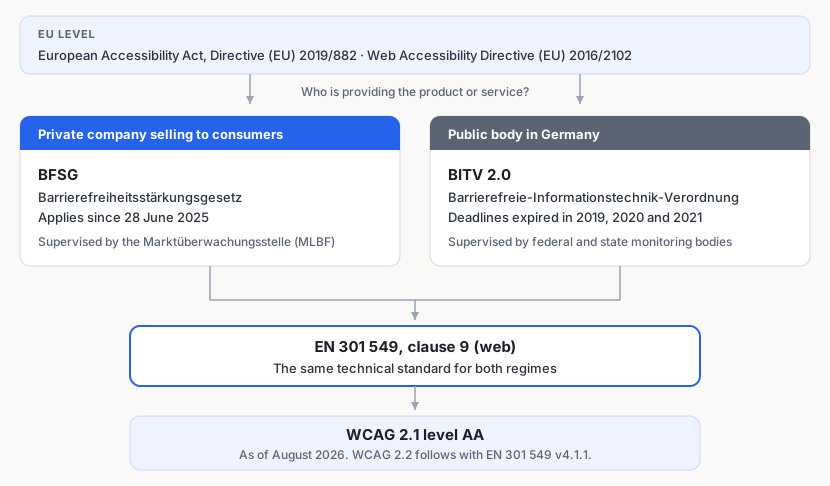 Enlarge: Two regimes, one technical standard. The split at the top decides your…
This is not legal advice. I am a web developer, not a lawyer. These pages describe how the rules work in practice. Whether and how they apply to your specific offering is a question for qualified legal counsel.
Key points
- The BFSG applies to companies, not to websites in general. It covers named products and named services sold to consumers. A brochure website with no covered service is usually outside its scope.
- Where your company is based does not matter. What matters is whether you offer a covered product or service to consumers in Germany.
- BITV 2.0 is a different regime for public bodies. It has stricter formal rules, including two duties with no European equivalent: German Sign Language and Leichte Sprache on the home page.
- The technical benchmark is EN 301 549. Clause 9 adopts the WCAG success criteria at levels A and AA without changing them. As of August 2026 that is WCAG 2.1 AA.
- WCAG 2.2 is not yet mandatory, and building to it anyway is cheaper than a second audit. EN 301 549 v4.1.1 will bring it in, and it takes legal effect only once the Official Journal cites it.
- Micro-enterprises providing services are exempt from the BFSG: fewer than 10 people and at most EUR 2 million turnover or balance sheet total. The exemption does not cover products.
- Fines run to EUR 100,000 for serious breaches, but no individual fine has been documented publicly. The realistic risk in 2026 is a warning letter from a competitor or a consumer complaint.
Which of the three applies to you
The three names get used interchangeably in English-language articles, which is where most of the confusion starts. They sit at different levels.
The European Accessibility Act (EAA) is Directive (EU) 2019/882. A directive binds member states, not companies. It obliges Germany to have a law; it is not itself the law you have to follow. Quoting the EAA at a German authority gets you nowhere.
The BFSG is that German law. The full name is Barrierefreiheitsstärkungsgesetz, which translates roughly as accessibility strengthening act. It has applied since 28 June 2025 and is the rulebook for private companies. Details are on BFSG: Germany’s Accessibility Act 2025.
BITV 2.0 is the older regulation for public bodies, based on the Web Accessibility Directive (EU) 2016/2102. Its deadlines expired years ago. It matters to companies mainly as suppliers: sell software to a German authority and your product has to meet it. See BITV 2.0: German Public Sector Rules.
A quick way to sort yourself: if your customer is a consumer, read the BFSG. If your customer is a German authority, read BITV 2.0. If both, you need both, because the paperwork differs even where the code does not.
The chain from directive to test criterion
Each level makes the one above it more concrete:
EAA, Directive (EU) 2019/882
        ↓  transposed into German law as
BFSG + BFSGV
        ↓  made technically concrete by
EN 301 549 (European standard)
        ↓  clause 9 adopts, for web content
WCAG 2.1 level AA → 50 testable success criteria
The public-sector chain runs in parallel: Directive (EU) 2016/2102 → BGG → BITV 2.0 → EN 301 549 → WCAG.
For day-to-day work this means you do not need four rulebooks in your head. You build to WCAG. The rest is the legal scaffolding that explains why it is mandatory, and it becomes relevant when you write your statement or answer an authority.
One detail matters for anyone documenting conformity. For the public-sector directive, EN 301 549 V3.2.1 is cited in the Official Journal, which creates a presumption of conformity. For the EAA, no version has been cited yet. A draft of v4.1.1 incorporating WCAG 2.2 went out for review in November 2025 and is expected in the Official Journal around October 2026. Until then EN 301 549 is the recognised state of the art in the private track rather than a formally harmonised standard. In practice you write “benchmark: EN 301 549, for web content WCAG level AA” instead of claiming conformity with a harmonised standard.
What accessible means here
Clause 9 of EN 301 549 contains no rules of its own. It renumbers the WCAG success criteria: WCAG 1.1.1 becomes 9.1.1.1, WCAG 2.4.7 becomes 9.2.4.7. If you know WCAG, you know clause 9.
For most websites the practical list is short and familiar: sufficient colour contrast, full keyboard operation with a visible focus indicator, meaningful alternative text, correctly labelled form fields, captions and transcripts for media, error messages a person can act on, and a consistent structure that assistive technology can build on.
Two clauses catch people out because they sit outside the WCAG. Clause 10 covers non-web documents, so the PDF invoice in the customer account is in scope. Clause 12 covers documentation and support services, so your help pages and your support channel are part of conformity, not an extra.
Where the two regimes differ
| BFSG | BITV 2.0 | |
|---|---|---|
| Who is bound | private companies selling to consumers | public bodies |
| Applies since | 28 June 2025 | 2019 to 2021, depending on the case |
| Statement required | yes, four items under Annex 3 no. 1 | yes, seven sections in the EU template |
| Update cycle for the statement | not specified | once a year, plus after major changes |
| Sign language and Leichte Sprache | not required | required on the home page |
| Supervision | Marktüberwachungsstelle der Länder (MLBF), Magdeburg | federal and state monitoring bodies |
| Sanctions | fines up to EUR 100,000 | administrative supervision, no fines |
The line that surprises most people is the last one. The regime with fines is the private one, and it is the newer of the two.
What to do first
- Establish whether you are covered. Product or service, consumer or business customer, micro-enterprise or not.
- Publish an accessibility statement. It is the cheapest obligation to meet and the easiest one for anyone to check from outside, which is exactly why complaints start there. The required contents are on German Accessibility Statement: Rules.
- Measure the current state against WCAG 2.2 AA rather than 2.1, so the next change of standard does not trigger a second audit.
- Set up a feedback channel with someone behind it. An unanswered report is the shortest route to a complaint, and BFSG Enforcement: Status in Germany sets out where that leads.
If you need external evidence rather than a self-assessment, the German market has a standardised procedure for it, described on BITV-Test: Accessibility Audits in Germany.
FAQ
Does the BFSG apply to companies based outside Germany?
Yes, if you offer a covered product or service to consumers in Germany. The law attaches to the market you serve, not to where your company is registered. A shop in Ireland shipping to German consumers is in scope; a purely business-to-business supplier without a consumer offering usually is not.
Is WCAG 2.2 mandatory in Germany?
Not as of August 2026. The binding version is EN 301 549 V3.2.1, which refers to WCAG 2.1 level AA. Version 4.1.1 will bring WCAG 2.2 and takes legal effect once it is cited in the Official Journal, expected around October 2026. Building to 2.2 now avoids a second audit later.
We already have a VPAT. Is that enough for Germany?
A VPAT is a template. Filled in with documented test results it becomes an ACR, and the EU edition documents against EN 301 549, which is the relevant standard here. It does not replace the German accessibility statement, because that has its own mandatory contents under Section 14 BFSG.
Who enforces the BFSG, and what happens first?
The Marktüberwachungsstelle der Länder für die Barrierefreiheit von Produkten und Dienstleistungen (MLBF) in Magdeburg. It has been running active checks since 29 January 2026. A case starts with a request for comment and a deadline to fix the problem. Fines are the last step, not the first.
Do these rules cover mobile apps as well as websites?
Yes. The law attaches to the service, not to the channel. A booking service delivered through a native app has the same obligations as the same service on the web, and clause 11 of EN 301 549 covers software including mobile apps.
Sources
- BFSG - the German act, official text (in German)
- Directive (EU) 2019/882 - European Accessibility Act, English text on EUR-Lex
- EN 301 549 V3.2.1 - the standard itself, free PDF from ETSI