German Accessibility Statement: Rules
A German accessibility statement (Barrierefreiheitserklärung) is the public account of how accessible a digital offering is. What has to go in it depends on your regime. Companies publish four items under Section 14 BFSG with Annex 3 no. 1. Public bodies publish seven sections under Section 12b BGG and Section 7 BITV 2.0, in the format of the EU template.
This split is why so many statements on German websites are half right. Almost every free template comes from the public-sector track. Used by a company, it cites a conciliation body that has no role there and omits the one item the BFSG names explicitly.
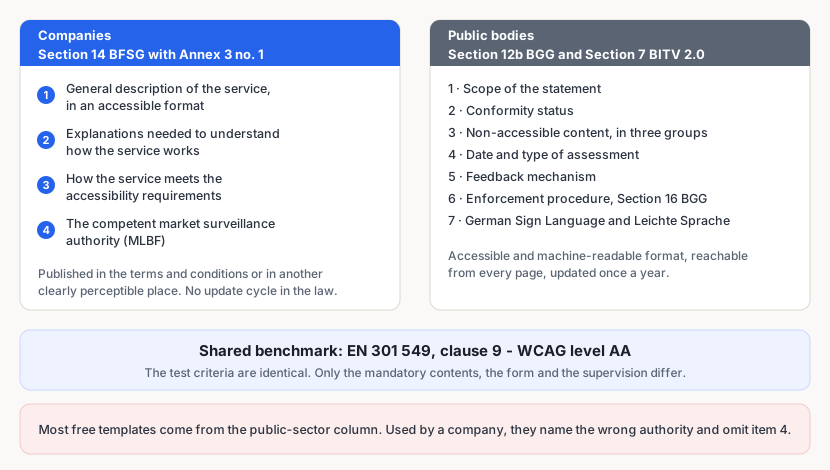 Enlarge: Four items on one side, seven sections on the other. The technical benchmark…
This is not legal advice. I describe structure and content from practice. The exact legal form depends on whether you declare as a public body or as a private provider. Have the final version checked if anything is at stake.
Key points
- Two regimes, two legal bases. Companies declare under Section 14 BFSG with Annex 3 no. 1. Public bodies declare under Section 12b BGG and Section 7 BITV 2.0, using the format of Commission Implementing Decision (EU) 2018/1523.
- The BFSG names four items, and the fourth one, the competent market surveillance authority, is the item copied templates leave out.
- Only public bodies need the conciliation reference. Section 34 BFSG opens the same procedure to consumers against companies, but naming it in the statement is not required there.
- Section 7 BITV 2.0 is strict about form: an accessible and machine-readable format, reachable from the home page and from every page of the site.
- Update cycle: public bodies once a year and after every substantial change. The BFSG names no cycle, so an annual review is the sensible self-imposed rule.
- The benchmark is EN 301 549, which points to WCAG level AA for web content. As of August 2026 that means WCAG 2.1 AA, with 2.2 available as a voluntary extra.
- “Partially compliant” is the normal state, not an admission of failure. A statement listing known gaps with a fix date holds up better than an unproven claim of full conformity.
- The statement itself has to be accessible. An HTML page, not a scanned PDF. This is the mistake that gets spotted fastest.
What the BFSG requires
The legal basis is Section 14 BFSG: a service may only be provided if the accessibility requirements are met and the information under Annex 3 no. 1 has been produced and made available to the public in an accessible form. Annex 3 no. 1 names four items:
- A general description of the service in an accessible format. Not just “our website”, but what the offering does, readable by everyone.
- The descriptions and explanations needed to understand how it works. How the service is used, what the steps are, what support exists.
- A description of how the service meets the accessibility requirements. This is the core, and the point where most statements turn vague.
- The competent market surveillance authority. As of August 2026 that is the Marktüberwachungsstelle der Länder für die Barrierefreiheit von Produkten und Dienstleistungen (MLBF) in Magdeburg.
On where to publish, Annex 3 allows the terms and conditions or another clearly perceptible place. In practice that means a dedicated page linked in the footer, in the same position as the imprint and the privacy policy. Putting the information only in the terms and conditions satisfies the letter and wastes the effect, because nobody looks for accessibility there.
Item 3 deserves a warning. “How the service meets the requirements” is not an invitation to write a marketing sentence. The statement carries weight once it names the benchmark (EN 301 549 with WCAG level AA), says what the claim rests on (self-assessment or external audit, with a date), and names the gaps where the claim does not yet hold. Those three elements separate a statement from a press release.
What BITV 2.0 requires
For public bodies the position is clearer and stricter. Section 12b BGG sets the contents, Section 7 BITV 2.0 sets the form:
- Accessible and machine-readable format. Scanned PDFs are out, which points to an HTML page with a proper heading structure.
- Reachable from the home page and from every page of the site. The footer link is a requirement rather than a convention.
- Updated once a year and additionally after every substantial change to the site or app. This is the rule broken most often. An assessment date from 2021 is a formal defect in 2026, however accessible the site actually is.
- Feedback mechanism and enforcement reference. Section 12b BGG requires a directly reachable, accessible electronic contact option and a reference to the conciliation procedure under Section 16 BGG.
Federal bodies have one more duty. Section 4 BITV 2.0 requires explanations on the home page in German Sign Language and in Leichte Sprache, covering the main content, the navigation and the accessibility statement itself. The BFSG track has no equivalent.
An annotated template for companies
The statement itself belongs in German, because it addresses consumers in Germany and the authority reads German. The commentary below each block explains what it is doing, so you can adapt it without losing a required item.
<h1>Erklärung zur Barrierefreiheit</h1>

<p>Diese Erklärung gilt für die Website www.example.de und den dort
angebotenen Onlineshop der Example GmbH.</p>
Scope. Name the domain and the service. Vague phrasing such as “our digital offerings” helps nobody and gets risky in a group with several brands, because it stays unclear which legal entity is declaring what.
<h2>Stand der Barrierefreiheit</h2>

<p>Wir orientieren uns an der Norm EN 301 549, die für Webinhalte auf die
WCAG in Stufe AA verweist. Der Onlineshop ist mit diesen Anforderungen
teilweise vereinbar. Grundlage ist eine interne Prüfung vom 3. März 2026.</p>
Items 3 and part of item 1. Three things in one block: the benchmark, the degree of conformity, and what the claim rests on with a date. Leave out the date and the whole paragraph loses its value.
<h2>Nicht barrierefreie Inhalte</h2>

<ul>
  <li>Die Bestellhistorie wird als PDF ohne Tags ausgeliefert. Eine
      getaggte Fassung ist für das vierte Quartal 2026 geplant. Auf
      Anfrage senden wir die Daten binnen zwei Werktagen als HTML.</li>
  <li>Das Kartenmodul auf der Filialseite ist mit der Tastatur nur
      eingeschränkt bedienbar. Die Adressen stehen zusätzlich als Liste
      darunter.</li>
</ul>
Known limitations. This section is where quality shows. Each entry needs the barrier, the consequence and either a fix date or a workaround. Sorting by area rather than by success criterion is what makes it readable: “checkout” and “product filter” mean something to a reader, “1.4.11” does not. Put the criterion number in brackets if you want it.
<h2>Barrieren melden</h2>

<p>Sie haben eine Barriere gefunden? Schreiben Sie an
<a href="mailto:barrierefreiheit@example.de">barrierefreiheit@example.de</a>.
Wir antworten innerhalb von fünf Werktagen.</p>
Feedback. An email address is enough. A form works too, as long as it is properly labelled and has no captcha. Naming a response time turns an address into a process, even though no provision requires one.
<h2>Zuständige Marktüberwachungsbehörde</h2>

<p>Marktüberwachungsstelle der Länder für die Barrierefreiheit von
Produkten und Dienstleistungen (MLBF), Magdeburg.</p>
Item 4, and the one that is missing from most company statements in the wild. It is also the easiest thing in the world for a complainant to check.
Two optional additions I would make anyway. Mention Section 34 BFSG, which gives consumers access to a free conciliation procedure against companies, even though the BFSG does not require you to name it. And note the date of the next planned review, so the statement carries its own reminder.
A German-language template for both regimes, ready to fill in, is on Muster-Barrierefreiheitserklärung (in German).
Partially compliant is the normal case
The most common worry in projects: if we list our gaps, we hand critics a checklist. The opposite is closer to the truth.
A statement claiming full conformity shifts the burden onto the provider, because every barrier anyone finds contradicts a public claim. A statement naming three gaps with fix dates documents a process in progress. For market surveillance the difference is large: the first case is a contradiction of your own words, the second is a status report.
One sentence has no place in any statement: “we are committed to accessibility”, standing alone. It appears in roughly every second German statement, says nothing about the actual state and satisfies no required item. A useful rule when editing: if a sentence names neither a standard, nor a date, nor a gap, it can go.
Common mistakes
- A public-sector template used by a company. Conciliation body instead of market surveillance authority, BITV instead of BFSG, and item 4 missing.
- The statement as a PDF. It breaks the form requirement in Section 7 BITV 2.0 for public bodies and is the wrong choice everywhere else. If it has to exist as a PDF, publish it in addition to the HTML page.
- No date, or a very old one. The fastest way to make a formal defect visible.
- A feedback address with nobody behind it. The mail lands in a shared inbox that nobody works through.
- Footer only, when every page is required. For public bodies Section 7 BITV 2.0 requires both the home page and every page.
- A list of criterion numbers with no explanation. “1.3.1, 2.4.7, 4.1.2” informs nobody except specialists.
FAQ
Does a company need the same statement as a public authority?
No. The formalised statement following the EU template, with the conciliation reference, applies to public bodies. As a company you satisfy Section 14 BFSG with the four items from Annex 3 no. 1. The content overlaps heavily; the mandatory items differ.
Can the statement be in English?
The obligation is to inform consumers in Germany, so German is the safe choice, and an English version alongside it is useful if you serve an international audience. Publish both, keep them in sync, and make clear which one is authoritative. The German version is what an authority will read.
How often does it have to be updated?
Public bodies: once a year and after every substantial change, under Section 7(6) BITV 2.0. For companies the BFSG names no cycle. An annual rhythm is the sensible rule, plus a review after a relaunch, a new payment method or a new booking flow.
Does the statement protect us from fines?
It covers the information duty, which is exactly what it exists for. It does not cover fines for actual barriers. A statement claiming conformity where there is none can make the position worse, which is why gaps belong in it with a reason and a schedule. What enforcement looks like in practice is on BFSG Enforcement: Status in Germany.
Is a generator from the web good enough?
As a skeleton yes, as a result no. Generators supply the structure. They do not know your test results or your open issues, and those two are the content that matters. What a documented assessment involves is on BITV-Test: Accessibility Audits in Germany.
Sources
- Section 14 BFSG - information duties of service providers, referring to Annex 3 no. 1 (in German)
- Section 7 BITV 2.0 - form, availability and updating (in German)
- Implementing Decision (EU) 2018/1523 - the EU model statement, English text