BITV 2.0: German Public Sector Rules
German public bodies are bound by BITV 2.0, the Barrierefreie-Informationstechnik-Verordnung, not by the BFSG. The regulation contains no test list of its own. Section 3 declares EN 301 549 to be the applicable standard, which means WCAG level AA for web content. What it adds on top are the accessibility statement, a feedback channel, monitoring, and two duties with no European equivalent: German Sign Language and Leichte Sprache.
For a company outside Germany this regulation matters in one situation, and it is a common one: you supply software or a digital service to a German authority. The authority is the obliged party, and the requirement lands in your contract.
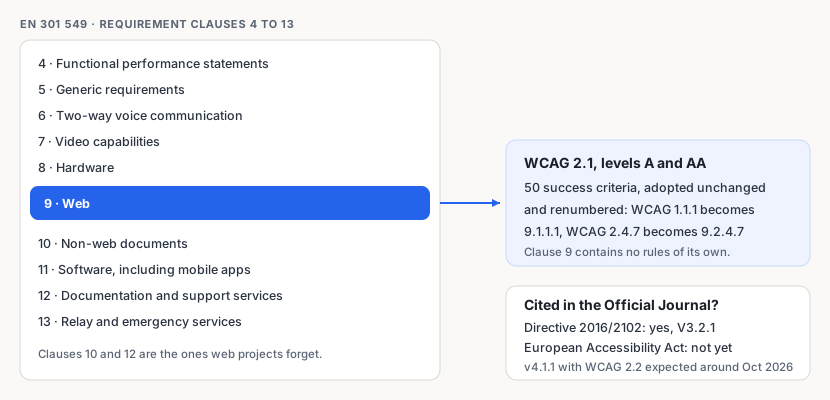 Enlarge: Clause 9 is the part web projects need, and it holds no rules of its own.…
This is not legal advice. This page describes how the regulation works in practice and does not replace legal counsel.
Key points
- BITV 2.0 binds federal public bodies. States, municipalities, schools and universities follow the equivalent state regulations, which usually track the federal model closely.
- The legal basis today is Section 12d BGG. The regulation dates from 2011 and was amended in May 2019 and in October 2023.
- Section 3(2) creates a presumption of conformity. Meet EN 301 549 in the version in force and your offering is presumed accessible. As of August 2026 that means WCAG 2.1 level AA for the web.
- Section 4 requires German Sign Language and Leichte Sprache on the home page, covering the main content, the navigation and the accessibility statement itself. The BFSG has nothing comparable.
- Section 7 governs the form of the statement: accessible and machine-readable, reachable from every page, updated once a year and after every substantial change.
- Section 8 governs monitoring: periodic sampling under the EU methodology, plus case-driven checks, with disability organisations consulted on the selection.
- All deadlines have passed: 23 September 2019 for newer websites, 23 September 2020 for existing ones, 23 June 2021 for mobile applications.
- There are no fines. Enforcement runs through administrative supervision, monitoring reports and the conciliation procedure, which is the opposite way round from the private-sector regime.
Who BITV 2.0 binds
The regulation applies to public bodies of the German federation. Germany is a federal state, so each of the 16 states has its own accessibility regulation for its own authorities, municipalities, schools and universities. Those state regulations are modelled on the federal one and rarely differ in substance for web work, though deadlines and reporting arrangements vary.
The practical consequence for a supplier: ask which body you are dealing with. A federal ministry, a state university and a municipal utility can all cite slightly different instruments, and all of them will end up pointing at EN 301 549.
Section 3 and the presumption of conformity
The most useful sentence in the regulation sits in Section 3(2): if the requirements of the harmonised standard EN 301 549, in the version in force, are met, the accessibility requirements are presumed to be fulfilled.
That reads like administrative prose and saves a great deal of argument. Without it, an authority would have to interpret what perceivable, operable, understandable and robust mean in each dispute. With it, meeting a specific testable standard is enough. The chain is:
BGG → BITV 2.0, Section 3 → EN 301 549 → WCAG 2.1 AA → individual success criteriaThe phrase “in the version in force” is a dynamic reference. When the standard moves, the regulation follows without an amending regulation. As of August 2026 the relevant version is V3.2.1 with WCAG 2.1 AA. Version 4.1.1 with WCAG 2.2 becomes binding once it is cited in the Official Journal, which is expected around October 2026. The same version question applies on the private side, as described on German Accessibility Law: BFSG, BITV & EAA.
Section 4: sign language and Leichte Sprache
This duty has no European model and is the sharpest difference from the BFSG track. The home page has to provide, in German Sign Language and in Leichte Sprache:
- information on the main content of the site,
- notes on navigation,
- an explanation of the main contents of the accessibility statement,
- pointers to further information available on the site.
Leichte Sprache is a regulated, simplified register of German with its own rules on sentence length, vocabulary and layout. It is not the same as plain language, and it is not something a translation tool produces.
The third item is the one most often missing. Checking German authority sites, you regularly find a sign language video about the home page and nothing explaining what the accessibility statement says. Formally that is a defect. In substance it is a contradiction, because the account of accessibility is then accessible only to part of its audience.
Section 7: the form of the statement
The contents of the statement come from Section 12b BGG, the form from Section 7 BITV 2.0:
- Accessible and machine-readable format. Scanned PDFs are excluded.
- Reachable from the home page and from every page of the site.
- Updated once a year, and additionally after every substantial change.
These three can be checked from outside in a few minutes without reading any code, which is why they are the most frequent formal finding. What belongs in the statement, and an annotated template, is on German Accessibility Statement: Rules.
Section 8: how monitoring works
Monitoring bodies at federal and state level run periodic samples following the EU methodology, in a simplified and an in-depth variant, and add case-driven checks when someone reports a problem. Disability organisations are consulted on the selection of sites, and the results feed into the reporting cycle under the Web Accessibility Directive.
There is no fine at the end of this. The instruments are the finding, the remediation request, the published report and the conciliation procedure under Section 16 BGG, which is free of charge and needs no lawyer. For a supplier the meaningful risk is reputational and contractual rather than regulatory: a monitoring report naming your product is an awkward document to have in a procurement file.
What EN 301 549 actually contains
The standard is much broader than the WCAG. Its title is “Accessibility requirements for ICT products and services”, and it was produced by CEN, CENELEC and ETSI. The requirements sit in clauses 4 to 13.
- Clause 4 sets functional performance statements, for example use without vision, without hearing or with limited reach. They apply where no specific requirement fits.
- Clause 5 holds generic requirements for any ICT.
- Clauses 6 and 7 cover two-way voice communication and video capabilities.
- Clause 8 covers hardware.
- Clause 9 is the web. It adopts the WCAG success criteria at levels A and AA unchanged and renumbers them.
- Clause 10 covers non-web documents, which is where PDF accessibility sits.
- Clause 11 covers software, explicitly including mobile apps.
- Clause 12 requires accessible documentation and accessible support services.
- Clause 13 covers relay and emergency services.
This structure is the reason a claim like “our product meets EN 301 549” says very little on its own. Which clauses? Clause 9 because it is a web application, clause 12 because it ships with documentation? A conformance report worth reading names the clauses.
If you supply a German public body
Four things are worth knowing before you sign.
The authority owes the duty, and passes it to you. Procurement documents increasingly name EN 301 549 with a conformance report. Read which clauses are asked for. A pure web application is usually clauses 9, 10 and 12.
Clause 12 is the one that catches suppliers out. Accessible documentation and an accessible support channel are separate requirements. A perfect interface with a scanned PDF manual fails.
A VPAT is not automatically enough. The EU edition documents against EN 301 549 and is the right one to use here. An ACR with “Supports” everywhere and no remarks is a warning sign to any experienced procurement officer, not a badge.
Ask which regulation applies. Federal, state or municipal changes the reporting route and sometimes the deadlines, though the technical benchmark stays the same. If the contract requires third-party evidence, the standardised German procedure is described on BITV-Test: Accessibility Audits in Germany.
FAQ
Does BITV 2.0 apply to private companies?
No. Private companies fall under the BFSG, which has applied since 28 June 2025 and is described on BFSG: Germany’s Accessibility Act 2025. BITV 2.0 reaches private companies only indirectly, through contracts with public bodies.
What is the difference between BITV 2.0 and EN 301 549?
BITV 2.0 is a German regulation and states who is bound and what has to be published. EN 301 549 is a European standard and states what accessible means technically. Section 3 of the regulation points at the standard, which is why the regulation itself is only ten sections long.
Is Leichte Sprache the same as plain language?
No. Leichte Sprache is a codified simplified register of German with published rules, including short sentences, a restricted vocabulary and specific typography. Plain language is a looser concept. Section 4 BITV 2.0 and its Annex 2 refer to the codified form.
Are there fines for public bodies under BITV 2.0?
No. Enforcement runs through supervision, monitoring reports and the conciliation procedure under Section 16 BGG. Fines exist in the private-sector regime instead, which surprises most people who assume the public sector is regulated more tightly.
Which EN 301 549 version applies right now?
V3.2.1 from March 2021, which refers to WCAG 2.1 level AA. Version 4.1.1 will bring WCAG 2.2 and takes effect once cited in the Official Journal, expected around October 2026. Because Section 3 uses a dynamic reference, the regulation follows automatically.
Sources
- BITV 2.0 - full text of the regulation (in German)
- EN 301 549 V3.2.1 - the standard, free PDF from ETSI
- Directive (EU) 2016/2102 - Web Accessibility Directive, English text