BFSG: Germany's Accessibility Act 2025
The Barrierefreiheitsstärkungsgesetz (BFSG) obliges private companies to make certain products and consumer services accessible. It has applied since 28 June 2025, it covers you regardless of where your company is registered as long as you serve consumers in Germany, and for websites and apps it leads to WCAG level AA. Whether it applies to you depends on two questions: is your offering one of the named products or services, and are you a micro-enterprise providing a service?
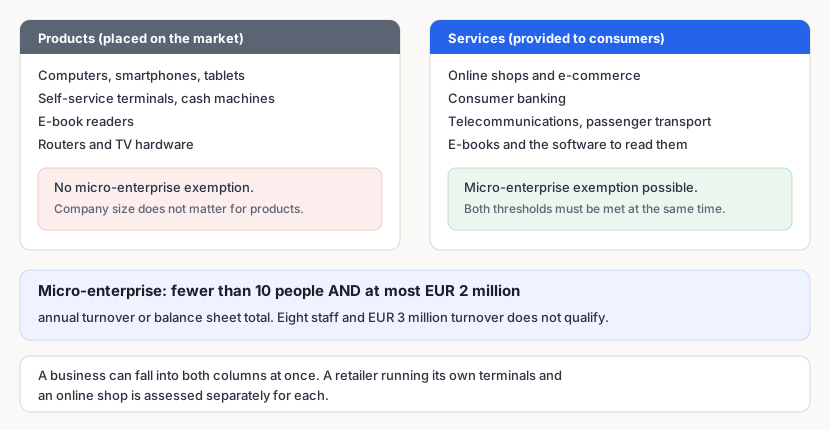 Enlarge: The exemption that most companies ask about applies to services only. For…
This is not legal advice. I am a web developer, not a lawyer. This page describes how the BFSG works in practice and does not replace legal counsel.
Key points
- In force since 28 June 2025. New websites, apps and online shops had no grace period at all.
- It attaches to the market, not to your registered office. A company outside Germany that offers a covered service to German consumers is in scope.
- Only named products and services are covered. Online shops, consumer banking, telecommunications, passenger transport, e-books and the software to read them are the ones that matter for the web.
- Business-to-business offerings are usually outside scope, until the same product is also sold to consumers.
- Micro-enterprises providing services are exempt: fewer than 10 people and at most EUR 2 million turnover or balance sheet total. Both thresholds at once, and never for products.
- Section 38 grants transition periods for existing arrangements only: service contracts and products already in use until 27 June 2030, self-service terminals for up to 15 years from commissioning.
- Fines reach EUR 100,000 for serious breaches under Section 37 and EUR 10,000 in other cases. No individual fine has been documented publicly as of summer 2026.
- You also have to publish information about accessibility. That duty sits in Section 14 with Annex 3 and is the one that gets checked first.
Who the BFSG covers
The law does not apply to every website. It attaches to a list of products and services offered to consumers. For web work, the service column is the one that matters.
| Products | Services |
|---|---|
| Computers, smartphones, tablets | E-commerce and online shops |
| Self-service terminals, cash machines, ticket machines | Consumer banking |
| E-book readers | Telecommunications services |
| Routers, TV hardware | Passenger transport: tickets, apps, booking |
| E-books and the software needed to read them |
The entry that pulls in the largest number of websites is e-commerce. If a consumer can conclude a contract with you online, you are providing a service in electronic commerce, and the accessibility requirements follow.
Three questions sort most cases:
- Do you sell to consumers? A purely business-to-business offering with no consumer element is generally outside scope.
- Is it one of the named products or services? A portfolio site with no covered service is usually not obliged, although accessibility still pays off in reach.
- Are you a micro-enterprise providing a service? If yes, the exemption probably applies to that service. Check it rather than assume it.
Products and services are assessed separately
The distinction between a product and a service looks academic and decides who can use the exemption. A product is a thing placed on the market: a phone, an e-book reader, a payment terminal. A service is what you provide through your website or app: the shop, the booking system, the banking access.
Some businesses are both at once. A retailer that operates its own terminals and runs an online shop is assessed as a service provider for the shop and as an economic operator for the terminal. Feeling generally exempt as a small company is where this goes wrong, because the exemption never reaches the product side.
The micro-enterprise exemption and its limits
A micro-enterprise employs fewer than 10 people and has at most EUR 2 million in annual turnover or balance sheet total. Three points decide whether you can rely on it.
Both thresholds have to hold together. Eight staff and EUR 3 million in turnover is not a micro-enterprise. Twelve staff and EUR 500,000 in turnover is not one either.
It covers services only. A manufacturer, importer or distributor of covered products cannot use it, whatever its size.
It is not permanent. Grow past either threshold and the exemption ends for the whole offering, not only for the growth. Anyone operating near a threshold is better off planning the work in rather than retrofitting it under time pressure.
There is also a group question. Being part of a larger structure can matter when the thresholds are assessed, so a small legal entity inside a group is not automatically a micro-enterprise.
Two worked examples
A travel agency with 9 staff and EUR 1.8 million in turnover sits below both thresholds, so the exemption probably covers its booking service. A language course provider with 5 staff but EUR 2.4 million in turnover breaks the turnover threshold and is not a micro-enterprise, despite the small team. One threshold is never enough.
Four cases from outside Germany
These are how I would read the situation. They are not a legal opinion, and mixed cases are worth checking with counsel.
- A US software company selling a consumer subscription to German customers. The contract is concluded online with consumers, so this is a service in electronic commerce and in scope. Sign-up, payment and account management all have to work with a keyboard and a screen reader.
- A UK retailer shipping to Germany. Same picture. The shop is the service, and the checkout is the part that gets tested first.
- A Dutch agency building a site for a German client. The agency is not the obliged party; its client is. In practice the requirement lands in the agency’s contract anyway, which is why procurement documents increasingly name EN 301 549.
- A French company with a German-language brochure site and no online contract. No covered service, so usually no obligation under the BFSG. That changes the day a booking form becomes a booking.
Transition periods under Section 38
The date 28 June 2025 is not a hard edge for everything. Section 38 staggers three cases, all of them about arrangements that already existed:
- Products used to provide a service. Products lawfully in use before 28 June 2025 may continue in use until 27 June 2030.
- Existing service contracts. Contracts concluded before the cut-off may run on unchanged until they end, and no later than 27 June 2030.
- Self-service terminals. Terminals commissioned before the cut-off may run to the end of their economic life, up to 15 years from commissioning.
None of this helps a new website. A transport operator whose ticket machines were installed in 2022 may run them until roughly 2037, while the booking app it launches in 2026 has to be accessible from day one.
Disproportionate burden under Section 17
If full accessibility would impose a disproportionate burden, an economic operator may partly step back from the requirements. This is narrow, and it comes with duties attached:
- The burden has to be assessed against the statutory criteria and documented in writing.
- The documentation has to be kept for five years and produced to market surveillance on request.
- The assessment has to be reviewed at least every five years, and whenever the service changes.
- Anyone who receives public or private funding for accessibility cannot claim disproportionate burden for the funded part.
- The competent authority has to be informed.
The measure is a ratio: the cost of accessibility against the operator’s total costs and revenue, and against the estimated benefit for people with disabilities, including how often and how long the service is used. One expensive detail on a rarely visited page weighs differently from a core step in the checkout.
Even where it applies, the provision only releases you from the part that is genuinely disproportionate. In practice the documented exemption is often more work than doing it properly would have been, because most WCAG requirements cost almost nothing when they are built in from the start.
What you have to publish
Beyond the technical work, the BFSG requires service providers to inform the public about the accessibility of their service. Section 14 with Annex 3 no. 1 names four items, and the fourth one is the one companies routinely omit because they copied a public-sector template. The required contents, the common mistakes and an annotated template are on German Accessibility Statement: Rules.
This is the obligation an outsider can verify in a minute without looking at a single line of code. That is exactly why complaints and warning letters start there.
Sanctions and supervision
Compliance is supervised by the Marktüberwachungsstelle der Länder für die Barrierefreiheit von Produkten und Dienstleistungen (MLBF), a joint body of the German federal states based in Magdeburg. It can find defects, require remediation and, in the last resort, take an offering off the market.
Breaches are administrative offences. Section 37 sets fines of up to EUR 100,000 for serious breaches, such as making non-accessible products available, and up to EUR 10,000 in other cases.
The sequence matters more than the figure. A case begins with a request for comment and a deadline to fix the problem, and most cases end there. Orders and fines come at the end of that chain. What gets expensive is ignoring the letter, and BFSG Enforcement: Status in Germany tracks what has actually happened so far.
Common misreadings
- “An overlay tool makes us compliant.” Accessibility widgets do not repair structural defects. They cover them, and many screen reader users find them disruptive. Accessibility happens in the markup.
- “This only concerns blind users.” Keyboard operation, contrast, captions, clear language and usability at high zoom help a wide range of people, including anyone in bright sunlight or with a broken mouse.
- “We did it once, so we are done.” Every new feature, redesign or embedded third party can introduce new barriers.
- “We are B2B, so nothing applies.” True until the same offering reaches consumers, which happens more often than expected through resellers or a self-service tier.
FAQ
Does the BFSG apply to a company registered outside the EU?
Yes, if it offers a covered product or service to consumers in Germany. The obligation follows the market, not the registered office. Distributors and importers have their own roles under the law, which is worth checking if you sell through a partner.
Which WCAG version does the BFSG require?
It does not name WCAG directly. It leads through EN 301 549, whose clause 9 adopts the WCAG criteria at levels A and AA. As of August 2026 the relevant version refers to WCAG 2.1 AA, with WCAG 2.2 expected to follow. The chain is set out on German Accessibility Law: BFSG, BITV & EAA.
We are a micro-enterprise. Do we have to do anything at all?
Legally, probably not, if the exemption applies cleanly to your service. Two cautions: the exemption ends when you grow past a threshold, and it never covers products. Many companies near the threshold plan the work in anyway rather than face a deadline later.
Is a BITV-Test required to prove compliance?
No. The BFSG requires accessibility and does not prescribe a test procedure. A documented audit plus an honest statement is enough for many companies. Where formal evidence is needed, for example in a tender, the standardised German procedure is described on BITV-Test: Accessibility Audits in Germany.
Do PDF documents and emails count?
If they are part of a covered service, yes. A PDF invoice in the customer account or a booking confirmation falls under clause 10 of EN 301 549, which covers non-web documents. This is a common gap in otherwise accessible shops.
Sources
- BFSG - full text of the act (in German)
- Section 17 BFSG - disproportionate burden, including the documentation duties (in German)
- Marktüberwachungsstelle der Länder (MLBF) - the supervising authority (in German)